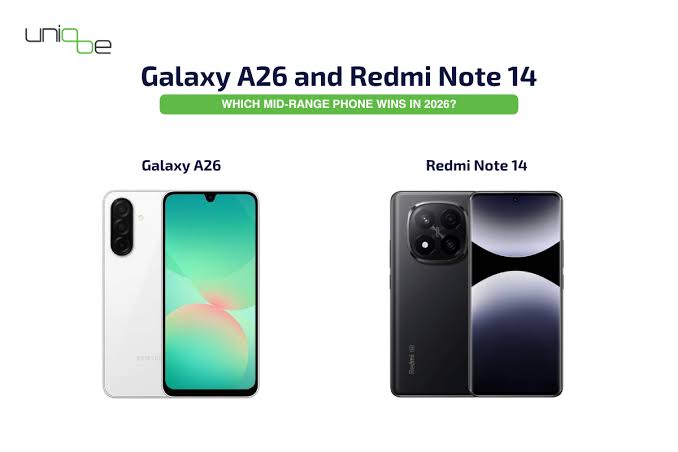
If you are shopping for a mid-range Android phone in Nigeria, the Samsung Galaxy A26 5G and Redmi Note 14 are two phones worth putting on your comparison list.
At first glance, the two phones look surprisingly similar. Both offer AMOLED displays with 120Hz refresh rates, multi-camera systems, large batteries, in-screen fingerprint sensors and modern Android-based software. However, the differences become much clearer when you look at the processor, network support, cameras, charging, software support and durability.
There is also an important detail that Nigerian buyers should know: the standard Redmi Note 14 sold on Xiaomi Nigeria’s website is a 4G model, while the Galaxy A26 5G supports 5G. Xiaomi also sells a separate Redmi Note 14 5G in some markets, so make sure you are comparing the correct version before buying.
In this guide, I will compare the Samsung Galaxy A26 vs Redmi Note 14 feature by feature so you can see where each phone differs and which specifications matter most for your type of use.
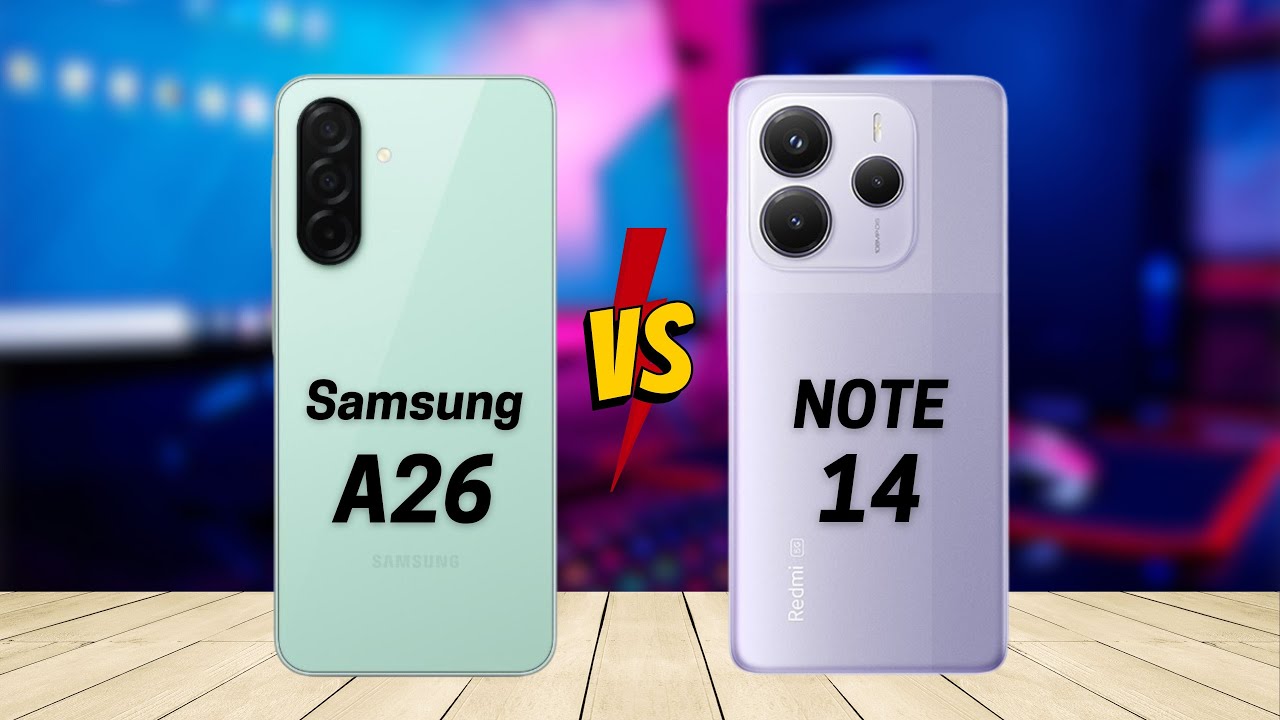
Samsung Galaxy A26 vs Redmi Note 14: Quick Comparison
| Feature | Samsung Galaxy A26 5G | Redmi Note 14 |
|---|---|---|
| Display | 6.7-inch Super AMOLED | 6.67-inch AMOLED |
| Refresh rate | 120Hz | 120Hz |
| Resolution | 1080 × 2340 | 2400 × 1080 |
| Main camera | 50MP with OIS | 108MP |
| Ultrawide | 8MP | No ultrawide on Nigerian 4G model |
| Front camera | 13MP | 20MP |
| Video | Up to 4K at 30fps | Up to 1080p at 60fps |
| Battery | 5,000mAh | 5,500mAh |
| Charging | 25W | 33W |
| Network | 5G + 4G | 4G |
| Storage expansion | microSD up to 2TB | microSD up to 1TB |
| Water/dust resistance | IP67 | IP54 |
| Software | Android / One UI | Android / Xiaomi HyperOS |
Samsung’s official specifications confirm the Galaxy A26’s 6.7-inch Super AMOLED 120Hz display, 50MP + 8MP + 2MP rear cameras, 5,000mAh battery, microSD support and 5G connectivity. Xiaomi’s Nigerian specifications list the Redmi Note 14 with a 6.67-inch 120Hz AMOLED display, 108MP main camera, 5,500mAh battery, 33W charging and 4G connectivity.
1. Display: Galaxy A26 vs Redmi Note 14
Both phones give you a 120Hz AMOLED experience, so neither one feels like a basic budget phone when you scroll through apps or watch videos.
The Galaxy A26 has a 6.7-inch Super AMOLED display with a 1080 × 2340 resolution and a refresh rate of up to 120Hz.
The Redmi Note 14 has a slightly smaller 6.67-inch AMOLED display with 2400 × 1080 resolution and a 120Hz refresh rate. Xiaomi also lists up to 1,800 nits peak brightness and 100% DCI-P3 coverage for the display.
In everyday use, both screens should provide a sharp and smooth experience. The Redmi also puts considerable emphasis on eye-care features, including TÜV Rheinland certifications and high-frequency PWM dimming.
Therefore, the display comparison is not simply about which phone has AMOLED. Both do. Look at brightness, colour reproduction, outdoor visibility and your own preference for Samsung’s One UI display experience versus Xiaomi’s HyperOS.
2. Camera: 50MP vs 108MP
This is where the specifications can be misleading.
The Galaxy A26 has a 50MP main camera with optical image stabilization, an 8MP ultrawide camera and a 2MP macro camera. Samsung also supports 4K video recording at 30fps.
The Nigerian Redmi Note 14 has a much higher-resolution 108MP main camera, supported by 2MP depth and 2MP macro cameras. Its official specifications list rear-video recording up to 1080p at 60fps. The phone also has a 20MP selfie camera.
So, why does the Samsung have a 50MP camera while the Redmi has 108MP?
Megapixels are only one part of camera performance. Sensor size, stabilization, lens quality, image processing and software all influence the final photograph.
Samsung’s inclusion of OIS is particularly useful for reducing camera shake. It can also help when taking photos in lower-light situations and when recording handheld video.
Meanwhile, Xiaomi’s 108MP sensor can capture highly detailed images in good conditions and supports its own in-sensor zoom and image-processing features.
If you frequently record video, the Galaxy A26’s 4K recording capability is an important specification to consider. If you mainly take high-resolution still photographs, the Redmi’s 108MP camera is also worth considering.
For more smartphone camera advice, you can also read my guide on mistakes Nigerians make when buying smartphones.
3. Performance: Which Phone Is Faster?
The processor is one area where you should look beyond the phone’s brand.
The Galaxy A26 uses an octa-core processor with CPU speeds listed by Samsung at up to 2.4GHz. Samsung’s official specifications identify the processor as an octa-core platform, while the exact chipset can vary by regional configuration.
The Nigerian Redmi Note 14 uses the MediaTek Helio G99-Ultra, built on a 6nm process, with an octa-core CPU reaching up to 2.2GHz and a Mali-G57 MC2 GPU.
For everyday tasks such as WhatsApp, Instagram, Chrome, YouTube, email, online learning and banking applications, both phones are designed for this type of workload.
Gaming requires a closer look. If you play demanding games, consider sustained performance, GPU capability, thermal management and storage speed instead of choosing based on RAM numbers alone.
My guide to smartphone requirements for gaming can help if gaming is one of your main reasons for upgrading.
4. Battery and Charging
Battery capacity is another obvious difference.
The Galaxy A26 has a 5,000mAh battery. Samsung lists up to 17 hours of video playback and supports 25W charging.
The Redmi Note 14 has a larger 5,500mAh battery and supports 33W turbo charging. Xiaomi also supplies a 33W charger with the Nigerian version according to its official specifications.
That gives Redmi an advantage on paper in both battery capacity and charging speed.
However, battery life is not determined by capacity alone. Screen brightness, processor efficiency, network strength, background applications and your usage habits all affect how long a phone lasts.
If you spend a lot of time away from a charger, the extra 500mAh on the Redmi may be useful. If battery health is your concern, my guide on extending smartphone battery life covers practical habits that can help.
5. 5G Connectivity
This is one of the clearest differences between these particular Nigerian models.
The Galaxy A26 supports 5G, including Sub-6 5G bands listed by Samsung.
The standard Redmi Note 14 listed on Xiaomi Nigeria’s website supports 4G, 3G and 2G.
That does not mean the Redmi Note 14 is a bad option for someone who currently uses 4G. A 4G connection can still provide enough speed for social media, streaming, browsing, video calls and many other everyday activities.
However, if you specifically want a 5G phone and want to keep it for several years, you need to pay attention to this distinction.
There is also a Redmi Note 14 5G model in other markets. Xiaomi’s African specifications show that version using the Dimensity 7025-Ultra processor, 5G connectivity, OIS and a different battery configuration.
Therefore, check the exact model number and Nigerian availability before purchasing a Redmi Note 14 advertised as 5G.
6. Software and Updates
Software support is an important difference that is easy to overlook when comparing hardware.
The Galaxy A26 runs Samsung’s Android-based software experience and Samsung lists a security update period through March 31, 2031 for the model.
The Redmi Note 14 uses Xiaomi HyperOS.
For someone who keeps a phone for several years, software support deserves almost as much attention as the camera or battery.
Updates can bring new features, security fixes and compatibility improvements. They also matter when you use your phone for banking, work, school or other sensitive activities.
If you want to understand more about protecting an Android phone, check my guide to cybersecurity in Nigeria.
7. Durability: Galaxy A26 vs Redmi Note 14
Durability is another area where the two phones take different approaches.
Samsung gives the Galaxy A26 an IP67 rating, while Xiaomi lists the Nigerian Redmi Note 14 with an IP54 rating.
The ratings are not identical, and they should not be interpreted as permission to deliberately expose either phone to water.
The Redmi Note 14 does have Corning Gorilla Glass 5 and Xiaomi describes its internal structure as reinforced. The company also highlights its testing against drops and other physical stresses.
Samsung’s IP67 rating provides a different type of protection, covering resistance to dust and water under specified laboratory conditions.
For Nigerian buyers who regularly use their phone outdoors, durability is worth considering alongside performance and camera specifications.
8. Storage and Memory
The Galaxy A26 supports microSD expansion of up to 2TB according to Samsung’s specifications. Its SIM tray uses a hybrid arrangement, meaning the second slot can accommodate either a SIM or microSD card.
The Nigerian Redmi Note 14 supports configurations including 6GB RAM with 128GB storage, 8GB with 128GB and 8GB with 256GB. Xiaomi lists expandable storage of up to 1TB.
Storage matters more than many first-time buyers realise. Photos, WhatsApp media, videos, games and downloaded documents can fill 128GB surprisingly quickly.
If you regularly record videos or keep lots of files on your phone, consider 256GB storage or make sure the model supports the type of expansion you need.
9. Audio and Extra Features
The Redmi Note 14 includes dual speakers, Dolby Atmos and a 3.5mm headphone jack. Xiaomi also includes an IR blaster, NFC and an in-screen fingerprint sensor.
The Galaxy A26 has a fingerprint sensor and NFC support in supported markets, but Samsung does not list a 3.5mm headphone jack on the device. The phone uses USB Type-C for wired connectivity.
If you still use traditional wired earphones with a 3.5mm plug, the Redmi’s headphone jack can be a practical advantage.
The IR blaster can also be useful if you want to control compatible appliances such as TVs or air conditioners from your phone.
10. Which Phone Is Better for Students?
For a student, I would look at the features that affect everyday schoolwork rather than focusing only on camera megapixels.
A good display helps with reading PDFs and watching lectures. Strong battery life is useful during long school days. Expandable storage can help if you download lots of documents and media.
The Redmi Note 14’s 5,500mAh battery, AMOLED display, 33W charging and 3.5mm headphone jack make its specification sheet interesting for students.
The Galaxy A26 brings 5G connectivity, Samsung’s software ecosystem, microSD expansion and a long listed security-support period.
If you are shopping specifically for a student phone, you can also read my best phones for university students in Nigeria guide.
11. Which Phone Is Better for Content Creators?
Content creators should pay attention to video capabilities, stabilization, microphones, storage and battery life.
The Galaxy A26 supports 4K video recording at 30fps and has OIS on its main rear camera.
The Nigerian Redmi Note 14 records rear video at up to 1080p 60fps according to Xiaomi’s specifications. Its 108MP main camera and 20MP selfie camera can still be useful for photography and social-media content.
If video recording is a major part of your work, do not compare these phones using megapixels alone. Check the actual recording resolutions, stabilization, audio options and storage capacity.
Samsung Galaxy A26 vs Redmi Note 14: What Should You Check Before Buying?
Before you hand over your money, check the exact variant being sold by the retailer.
- Confirm the network version: Make sure you know whether you are buying the 4G or 5G version.
- Check the storage: 128GB may be enough for some users, while others will benefit from 256GB.
- Check the warranty: Ask the seller what warranty applies to the device.
- Verify the model: Do not rely only on a product title such as “Redmi Note 14.”
- Check the charger: Charging support and what comes in the box can vary by market.
- Compare current prices: Nigerian smartphone prices can change because of exchange rates, retailer margins and stock availability.
- Check the official specifications: Compare the exact variant with the manufacturer’s website before paying.
You can also compare your options with my broader 2026 smartphone buying guide for Nigeria.
Samsung Galaxy A26 vs Redmi Note 14: Final Thoughts
The Galaxy A26 and Redmi Note 14 are built around different strengths.
The Galaxy A26 5G combines a 120Hz Super AMOLED display, 50MP OIS camera, 4K video recording, 5G connectivity, microSD expansion and an IP67 rating. Samsung also lists security support through March 2031 for the model.
The Redmi Note 14 gives you a 108MP main camera, 5,500mAh battery, 33W charging, 120Hz AMOLED display, 3.5mm headphone jack, IR blaster, expandable storage and IP54 protection. The Nigerian model is a 4G phone.
That means the choice comes down to which specifications matter most to you. Someone who wants 5G, 4K video recording, Samsung’s software ecosystem and a higher IP rating will look at the Galaxy A26’s specifications differently from someone who values a larger battery, faster charging, a 108MP camera and a headphone jack.
Most importantly, make sure you compare the exact Nigerian variants. The Redmi Note 14 name covers different configurations in different markets, including a separate 5G version.
For more smartphone comparisons and buying guides, explore the Infolandia smartphone buying guide, check out our 2026 phone price guide, or visit the Infolandia Bookstore.
Before buying, you can verify the Samsung Galaxy A26 specifications directly on Samsung’s website and the Redmi Note 14 specifications on Xiaomi Nigeria’s official website.